Aerospace Medicine Milestones
Narrated 100 Year History of Aerospace Medicine
Slideshow of 100 year history of Aerospace Medicine developed and narrated by USN CAPT Walter Dalitsch, MD, MPH in conjunction with the Aerospace Medical Association History and Archives Committee
Timeline of Aerospace Medicine Milestones
1783
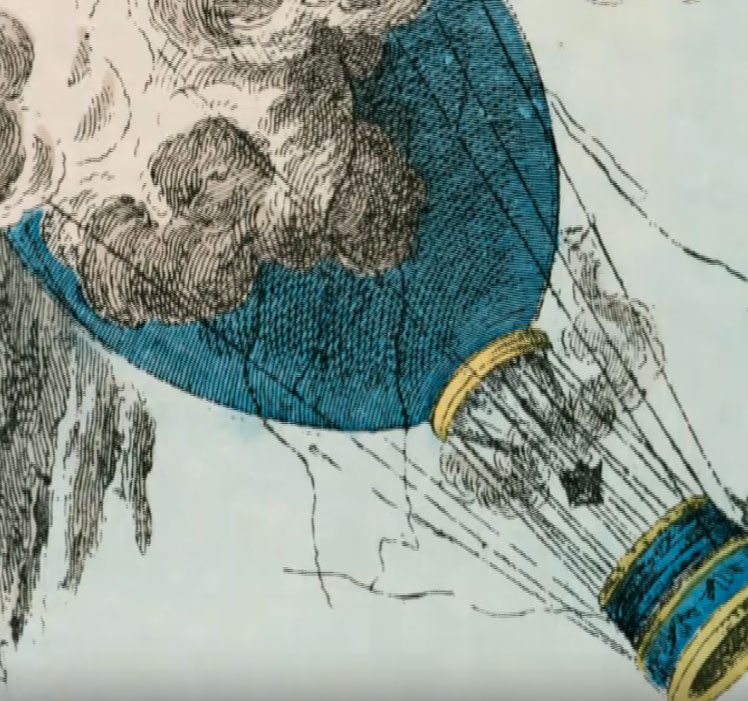
French science teacher Jean-François Pilâtre de Rozier (1754–1785) and the Marquis d’Arlandes make the first manned free balloon flight.
1785
Boston military surgeon and scientist John Jeffries (1744–1819) is the first physician aloft when he crosses the English Channel in a balloon flight with French inventor Jean-Pierre Blanchard (1753–1809).
Pilâtre de Rozier (1754–1785) and Pierre Romain are first aviation aviation human fatalities when their balloon plummets from 1500 ft near Wimereux in the Pas-de-Calais.
1875
French scientists Gaston Tissandier Joseph Croce-Spinelli and Théodore Sivel reach an altitude of 28,000 ft in their balloon using oxygen in sheepskin bags provided by physiologist Paul Bert (1833–1886). Running out of oxygen, Croce-Spinelli and Sivel become first aviation fatalities due to hypoxia, while Tissandier provides the mishap report.
1878
Paul Bert (1833–1886), the “Father of Aviation Physiology,” publishes La Pression barometrique, the first extensive studies on hypoxia using the altitude chamber.
1908
Navy Lieut. George C. Sweet (1877–1953) serves as the official Navy observer for the Wrights’ demonstration of flight for the U.S. Army.
Lieutenant Frank Lahm becomes the first U.S. Army officer to fly in an airplane.
U.S. Army purchases its first dirigible.
1Lt Thomas E. Selfridge dies in an airplane crash.
1910
U.S. Navy Capt. Washington Irving Chambers (1856–1934) meets with aviation pioneer Glenn Curtiss (1890–1958) to discuss possibility of aircraft aboard Navy ships.
Eugene Ely (1886–1911) flies a four-cylinder Curtiss biplane off the flat, wooden decks of the USS Birmingham.
1911
Lt. Benjamin D. Foulois, the pilot commanding the small aviation detachment in San Antonio, TX, draws up aeromedical regulations for the U.S. Army.
1912
The U.S. War Department prepares a medical exam to evaluate military pilot candidates.
The U.S. Navy Bureau of Medicine and Surgery issues first physical standards for Naval Aviation candidates.
1913
U.S. Naval Aviators conduct winter demonstration maneuvers and rides in Cuba.
1914
Dr. Adna G. Wilde (1885–1977) serves as surgeon for the Signal Corps Aviation School at North Island, CA.
1916
The Surgeon General of the U.S. Army approves 1Lt (Dr.) William R. Ream to participate in flying duties.
While serving as surgeon to the 3rd Aero Squadron, 1Lt (Dr.) Ralph P. Greene receives orders to “perform observations of human beings while participating in flight,” becoming the first U.S. medical officer ordered to flying duty. Dr. Greene later serves as the 2nd president of the Aerospace Medical Association.
1917
U.S. Army Lt. Col. Theodore C. Lyster (1875–1933) serves as first Chief Surgeon of the Army Signal Corps as America enters the First World War. That December he observed medical support of aviation units at the front lines.
1918
The U.S. Army Air Service establishes its “Medical Research Laboratory and School for Flight Surgeons” at Hazelhurst Field, Long Island, NY.
The term “flight surgeon” is officially adopted by the U.S. Army Air Service Medical Research Laboratory.
Army Flight Surgeon Col. Isaac H. Jones (1881–1956) publishes his book Equilibrium and Vertigo that explores this aspect of flight physiology.
Major (Dr.) William R. Ream is killed when his aircraft stalls on landing in Illinois.
The U.S. Army graduates its first class of flight surgeons (sources disagree on the exact date).
1921
The Medical Research Laboratory is damaged by a significant fire and reconstituted the following year as the “School of Aviation Medicine.”
1922
Five U.S. Navy lieutenants graduate from the School of Aviation Medicine as flight surgeons [click on the photo to the right for a larger view]. Lt. Bertram Groesbeck, Jr. (1894–1968), is first U.S. Naval medical officer to receive wings as a Naval Aviator.
1923
Navy Flight Surgeon Lt. Victor S. Armstrong is assigned as first Chief of Aviation Medicine Division for the U.S. Navy.
1925
The Air Corps Physiologic Research Laboratory at Wright Field, Dayton, OH, investigates hypobaric states, hypoxia, and the effects of centrifugal force on pilots.
1926
The U.S. Army’s School of Aviation Medicine moves from Long Island to Brooks Field, TX.
Dr. Louis H. Bauer, head of U.S. Army School of Aviation Medicine, publishes a textbook entitled Aviation Medicine.
1927-1934
Dr. William Ocker (1880–1942) develops an instrument flying course for the U.S. Army Air Corps. In 1930 he publishes an article on “blind flying” (Instrument flight) in the Journal of Aviation Medicine.
1927-1936
U.S. Navy Flight Surgeons are trained at the Navy Medical School at Bethesda, MD.
1929
Lt. Frederick Ceres is the first U.S. Navy medical officer to make a parachute jump.
The Aero Medical Association holds its first meeting in Detroit, MI.
The Division of Aviation Medicine is established at the U.S. Navy Bureau of Medicine and Surgery.
1930
The first issue of The Journal of Aviation Medicine is published by the Aero Medical Association.
1931
The U.S. Army School of Aviation Medicine moves to Randolph AFB, TX.
1932
U.S. Army aviators Maj. William C. Ocker (1880–1942) and First Lt. Carl J. Crane (1900–1982) publish their textbook Blind Flying on instrument flight. Their research is assisted by Army Flight Surgeons Col. Isaac H. Jones (1881–1956) and Capt. David A. Myers (1876–1957).
1936
The first day of the annual meeting of the Aero Medical Association is held aboard USS Lexington in Texas.
1937
U.S. Army Flight Surgeon Col. (Ret.) Isaac H. Jones publishes Flying Vistas: The Human Being as seen through the Eyes of the Flight Surgeon.
The first real oxygen mask is invented by U.S. Naval medical personnel. It consists of a painter’s mask, tube, and an oxygen-filled cylinder. Prior to this, aviators drew oxygen into their mouths via a straw.
1939
Dr. Harry Armstrong publishes his textbook Principles and Practice of Aviation Medicine.
The U.S. Navy establishes its own School of Aviation Medicine at Pensacola, FL. Five naval flight surgeons graduate from the school on 30 Nov. 1940.
1940
U.S. Navy Flight Surgeon Cmdr. John R. Poppen (1893–1965) helps develop an anti-G suit at the Medical Research Section of the Bureau of Aeronautics.
Ross McFarland, known for physical standards and altitude physiology, is commissioned in the U.S. Naval Reserves.
1941
Hollywood releases the movie Dive Bomber, starring Errol Flynn as a Navy Flight Surgeon researching the problem of “black out,” or G-induced loss of consciousness. The movie is loosely based on the work of Navy Flight Surgeon Capt. John. R. Poppen (1893–1965).
1942
Requirements are established for Aviation Medical Examiners to change their designation to Flight Surgeons.
The first set of U.S. Navy Flight Surgeon wings is hurriedly fabricated by the Dental Department at the Naval Air Station in Pensacola, FL.
Lt. Col. (Dr.) William R. Lovelace makes the first aircraft flight using pressure breathing. The following year Dr. Lovelace performs the highest altitude parachute jump ever attempted at that time (40,000 ft/12,192 m) while serving as president of AsMA.
1945
The U.S. Navy’s School of Aviation Medicine graduates more than 1500 flight surgeons during World War II. Of those, 21 were also designated as Naval Aviators.
1946
The Secretary of the Navy renames the school as the U.S. Naval School of Aviation Medicine and Research. It is administered under the Naval Air Training Command with Capt. Louis Iverson as officer-in-charge.
1947
The U.S. Air Force separates from the U.S. Army.
1948
The Berlin Airlift resupplies European populations after a Soviet blockade severs access by rail and water routes.
1949
British Flight Surgeon and former Wing Commander, Royal Air Force Volunteer Reserve, Kenneth G. Bergin publishes Aviation Medicine: Its Theory and Application.
1950-1953
Air rescue of wounded combat troops is established as an integral part of U.S. fighting forces.
1954
The Aero Medical Association celebrates its 25th anniversary.
1955
Aerospace Medicine is designated a board-certified specialty within the American Board of Preventive Medicine.
The U.S. Navy establishes a residency in aerospace medicine.
1957
During the International Geophysical Year, Russia launches Sputnik 1, the first artificial Earth satellite.
1964
The Coriolis Acceleration Platform and Vestibular Unit is dedicated at the U.S. Navy School of Aviation Medicine.
1965
The first class of U.S. Navy physiologists completes flight training. Graduates are named Rhodes, Bird, and Smith.
1981
Ken Gillingham’s video about G-LOC and the anti-G straining maneuver is massed produced for use in our APTUs.
1995
Developed by Navy Flight Surgeon Capt. Angus Rupert, the Tactile Situation Awareness System (TSAS), using tactile skin stimulators in a vest and seat pan, shows promise in significantly mitigating spatial disorientation in flight. The first flight of TSAS in the T-34 fixed-wing trainer was this month, and the program continued for a total of seven flight tests.
2003
U.S. Navy Flight Surgeons Capts. David M. Brown (dual designator) and Laurel S. Clark (Flight Surgeon) are killed when Space Shuttle Columbia explodes on re-entry during STS-107.
References
- Foulois BD. Handwritten notes from his papers in the USAF Academy Library, Box 24. Colorado: USAF Academy Library; n.d.
- Foulois BD. Letter to Maj. David A. Myers, M.C., 10 May 1936, from the Foulois papers in the Library of Congress, Box 4, Folder 4. Washington (DC): Library of Congress; n.d.
- Foulois BD. Letter to Dr. Ralph P. Greene, 2 Oct 1925, from the Foulois papers in the Library of Congress, Box 3, Folder 10. Washington (DC): Library of Congress; n.d.
- Link MM, Coleman HA. Medical Support of the Army Air Forces in World War II. Washington (DC): Office of the Surgeon General, USAF; 1955.
- Marion FL. That Others Might Live: USAF Air Rescue in Korea. Air Force History and Museums Program; 2004.
- Maurer M. Aviation in the U.S. Army 1919-1939. Washington (DC): Office of Air Force History; 1987.
- McFarland SL. A Concise History of the U.S. Air Force. Air Force History and Museums Program; 1997.
- Myers DA. Letter to Maj. Gen. (Ret.) Benjamin D. Foulois, 5 May 1936, from the Foulois papers in the Library of Congress, Box 4, Folder 4. Washington (DC): Library of Congress; n.d.
- Plunges to Death in ‘Flying Circus.’ The New York Times, 25 Aug. 1918, page 12.
- Walker LE, Wickham SE. From Huffman Prairie to the Moon: The History of Wright-Patterson Air Force Base. Washington (DC): U.S. Government Printing Office; circa 1983.
- Wilde AG. Letter to Maj. Gen. (Ret.) Benjamin D. Foulois, 22 Jan. 1963, from the Benjamin D. Foulois papers in the Library of Congress, Manuscript Division, Box 6, Folder 29. Washington (DC): Library of Congress; n.d.
Dr. Mark Campbell ([email protected]) if you wish to recommend additions to this timeline.
AsMA History
Trace the history of AsMA from its founding in 1929 to its role today as a global leader in aerospace medicine, advancing innovation and collaboration across decades of scientific progress.

AsMA Year by Year
Each year, a member is elected to be President, with their term culminating in the Annual Scientific Meeting. Explore this list of Past Presidents and meeting locations.